GraphQL Federation for Java Backend Developers
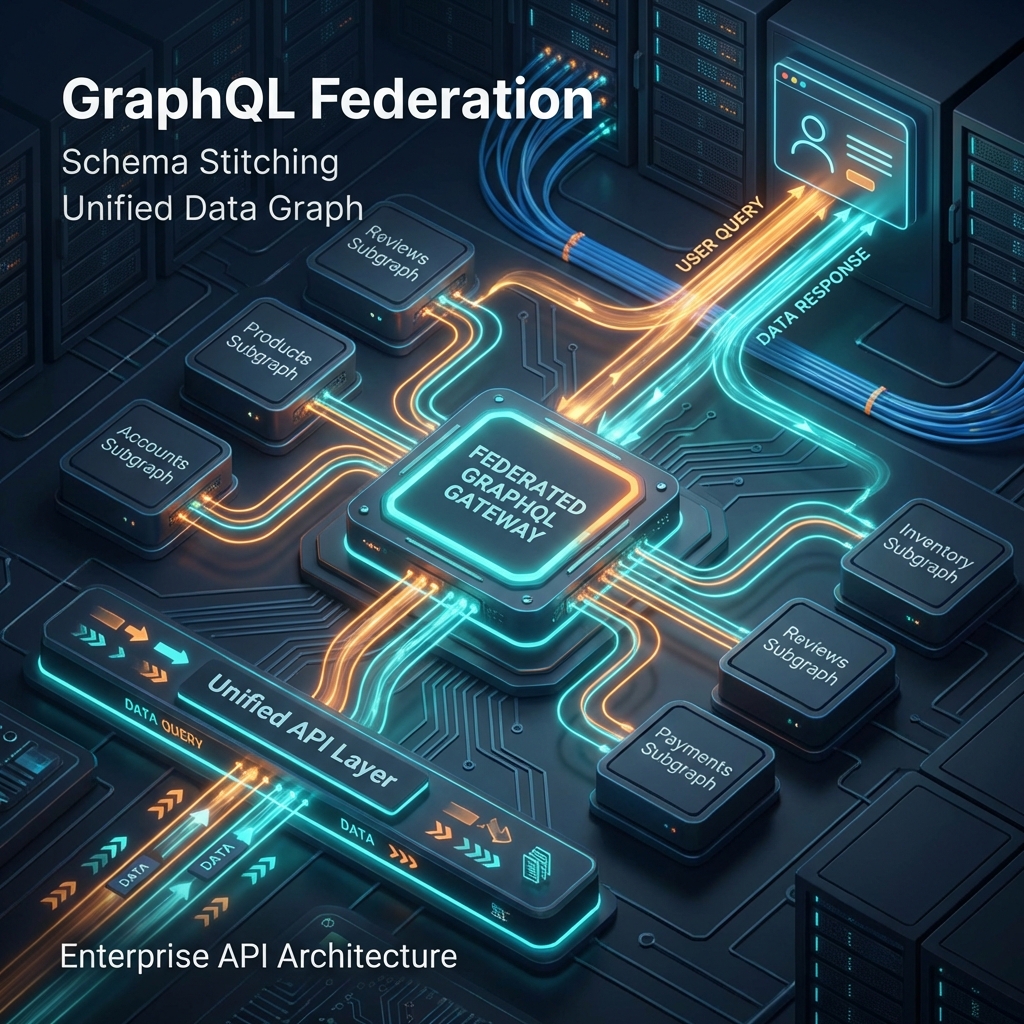
The API Gateway Problem
You have 5 microservices, each with its own REST API. Your frontend team builds a user dashboard that needs data from all 5. The result? 5 HTTP requests, waterfall loading, and slow UX.
GraphQL Federation solves this: one query, one request, automatic data aggregation.
Federation vs. Monolithic GraphQL
Monolithic GraphQL: One giant schema, one service.
Federation: Each microservice owns part of the schema, a gateway stitches them together.
Example: E-commerce System
# User Service owns User
type User @key(fields: "id") {
  id: ID!
  email: String!
}

# Order Service extends User with orders
extend type User @key(fields: "id") {
  orders: [Order!]!
}
The gateway automatically fetches user data from User Service, then enriches it with orders from Order Service.
Implementing with Spring GraphQL
Subgraph (Microservice) Setup
@Controller
public class UserController {

    @QueryMapping
    public User user(@Argument String id) {
        return userService.findById(id);
    }

    @SchemaMapping(typeName = "User")
    public List<Order> orders(User user) {
        // Called by Federation gateway to resolve orders
        return orderClient.getOrdersForUser(user.getId());
    }
}
Schema Definition
type Query {
  user(id: ID!): User
}

type User @key(fields: "id") {
  id: ID!
  email: String!
  orders: [Order!]!
}

type Order {
  id: ID!
  total: Float!
}
The Federation Gateway
Use Apollo Gateway or Spring Cloud Gateway with GraphQL support:
spring:
  cloud:
    gateway:
      routes:
        - id: graphql-federation
          uri: http://gateway:4000
          predicates:
            - Path=/graphql
The gateway handles:
- Query planning: Determining which services to call
- Data merging: Combining responses
- Caching: Avoiding redundant requests
N+1 Query Problem
GraphQL’s biggest pitfall: the N+1 problem.
Bad (N+1 queries):
@SchemaMapping
public Order order(User user) {
    return orderService.findById(user.getOrderId());  // 1 query per user!
}
Good (DataLoader batching):
@Bean
public DataLoader<String, Order> orderLoader(BatchLoaderRegistry registry) {
    registry.forTypePair(String.class, Order.class)
        .registerBatchLoader((ids, env) ->
            orderService.findAllById(ids)  // Single batched query
        );
    return DataLoaderFactory.newDataLoader(batchLoader);
}

@SchemaMapping
public CompletableFuture<Order> order(User user, DataLoader<String, Order> loader) {
    return loader.load(user.getOrderId());
}
Security in Federation
Never expose internal microservice GraphQL endpoints. Only the gateway should be public.
@Configuration
public class SecurityConfig {

    @Bean
    SecurityFilterChain filterChain(HttpSecurity http) throws Exception {
        return http
            .authorizeHttpRequests(auth -> auth
                .requestMatchers("/graphql").hasRole("API_USER")
                .anyRequest().denyAll()
            )
            .build();
    }
}
When NOT to Use Federation
| Scenario | Better Choice |
|---|---|
| Services rarely need data from each other | Separate REST APIs |
| Real-time updates critical | GraphQL Subscriptions + WebSockets |
| Team unfamiliar with GraphQL | Traditional API Gateway (Spring Cloud Gateway) |
Conclusion
GraphQL Federation turns multiple microservices into a single, cohesive API without tight coupling. Your backend stays distributed, but your frontend gets a unified data graph.
Building distributed systems? Check out Sagas for transactions or Transactional Outbox for messaging.