The Developer Platform: Kubernetes-Native Spring Boot
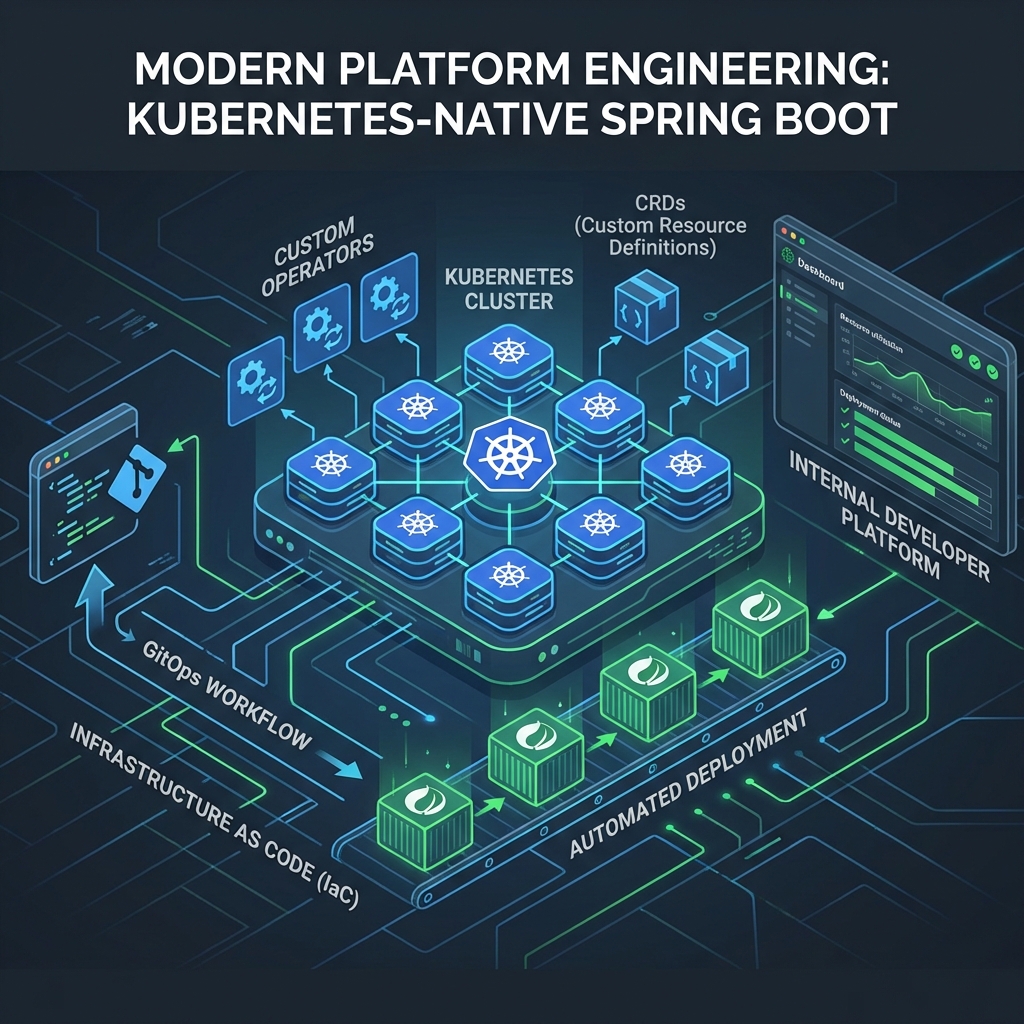
Platform Engineering: The New DevOps
Developers shouldn’t need to understand Kubernetes YAML to deploy their apps. Platform Engineering creates self-service abstractions that hide complexity.
The goal: git push → deployed to production, with zero manual infrastructure work.
Custom Resource Definitions (CRDs)
CRDs let you extend Kubernetes with your own resource types.
Example: SpringBootApp CRD
apiVersion: platform.example.com/v1
kind: SpringBootApp
metadata:
  name: my-app
spec:
  image: myregistry/app:v1.0
  replicas: 3
  database:
    type: postgres
    size: small
  cache:
    enabled: true
This single CRD automatically provisions:
- Deployment + Service
- PostgreSQL database
- Redis cache
- Ingress with TLS
Building a Kubernetes Operator
Operators watch CRDs and reconcile desired state.
Spring Boot Operator (Java K8s Client)
@Component
public class SpringBootAppReconciler {
    private final KubernetesClient client;

    @Scheduled(fixedDelay = 10000)
    public void reconcile() {
        var apps = client.resources(SpringBootApp.class).list().getItems();

        for (var app : apps) {
            ensureDeployment(app);
            ensureDatabase(app);
            ensureIngress(app);
        }
    }

    private void ensure Deployment(SpringBootApp app) {
        var deployment = new DeploymentBuilder()
            .withNewMetadata()
                .withName(app.getMetadata().getName())
            .endMetadata()
            .withNewSpec()
                .withReplicas(app.getSpec().getReplicas())
                .withNewTemplate()
                    .withNewSpec()
                        .addNewContainer()
                            .withImage(app.getSpec().getImage())
                            .withName("app")
                        .endContainer()
                    .endSpec()
                .endTemplate()
            .endSpec()
            .build();

        client.resource(deployment).createOrReplace();
    }
}
GitOps Integration
Connect your operator to Git for declarative infrastructure:
@Component
public class GitOpsController {

    @Scheduled(fixedDelay = 60000)
    public void syncFromGit() {
        var manifests = gitRepo.getManifests();

        for (var manifest : manifests) {
            var app = parser.parse(manifest, SpringBootApp.class);
            client.resource(app).createOrReplace();
        }
    }
}
Now your infrastructure is code-reviewed, versioned, and auditable.
Self-Service Developer Experience
Developers interact via simple commands:
# Create an app
kubectl apply -f myapp.yaml

# Scale
kubectl patch springbootapp my-app -p '{"spec":{"replicas":5}}'

# View status
kubectl get springbootapp my-app
The operator handles all the Kubernetes complexity.
Production Patterns
1. Status Reporting
Update CRD status so developers see deployment progress:
app.getStatus().setPhase("Provisioning");
app.getStatus().setDatabaseReady(false);
client.resource(app).updateStatus();
2. Garbage Collection
Use owner references for automatic cleanup:
deployment.getMetadata().setOwnerReferences(List.of(
    new OwnerReferenceBuilder()
        .withApiVersion(app.getApiVersion())
        .withKind(app.getKind())
        .withName(app.getMetadata().getName())
        .withUid(app.getMetadata().getUid())
        .withController(true)
        .build()
));
When the CRD is deleted, Kubernetes auto-deletes owned resources.
When to Build a Platform
| Signal | Action |
|---|---|
| Developers copy-paste K8s YAML | Build a platform |
| Onboarding new services takes days | Build a platform |
| Configuration drift between envs | Build a platform |
| < 10 services total | Wait, use Helm charts |
Conclusion
Kubernetes-native platforms turn infrastructure into code. By building operators with Spring Boot, you leverage familiar Java patterns while providing developers with a self-service experience that scales.
Building distributed systems? Check out Saga Pattern or GraphQL Federation.