Spring Boot Production Checklist: 15 Critical Settings
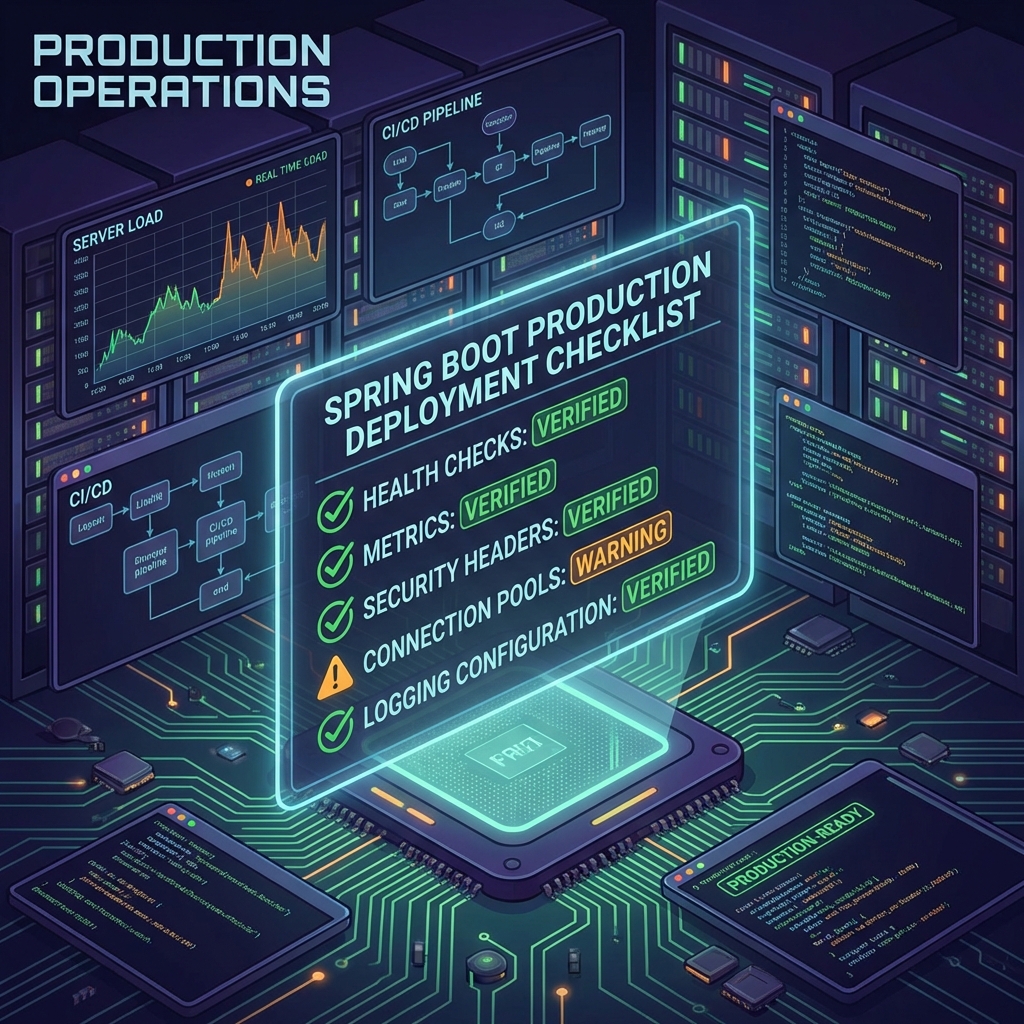
Production-Ready Spring Boot: A Checklist
Your app works in development. It’ll crash in production unless you configure these 15 critical settings.
1. Actuator Health Checks
Why: Kubernetes/AWS need to know when your app is ready.
management:
  endpoint:
    health:
      enabled: true
      show-details: always
  health:
    livenessState:
      enabled: true
    readinessState:
      enabled: true
2. Graceful Shutdown
Why: Prevent dropped requests during deployment.
server:
  shutdown: graceful
spring:
  lifecycle:
    timeout-per-shutdown-phase: 30s
3. Connection Pool Tuning
Why: Default pool size (10) is too small for production.
spring:
  datasource:
    hikari:
      maximum-pool-size: 20
      minimum-idle: 5
      connection-timeout: 30000
      idle-timeout: 600000
Rule of Thumb: max-pool-size = (num_cpu_cores * 2) + effective_spindle_count
4. Logging Configuration
Why: Debug logs in production kill performance.
logging:
  level:
    root: WARN
    com.yourcompany: INFO
  pattern:
    console: "%d{yyyy-MM-dd HH:mm:ss} - %msg%n"
  file:
    name: /var/log/app.log
    max-size: 10MB
    max-history: 30
5. Security Headers
Why: Protect against XSS, clickjacking, MIME sniffing.
@Bean
SecurityFilterChain filterChain(HttpSecurity http) throws Exception {
    return http
        .headers(headers -> headers
            .contentSecurityPolicy("default-src 'self'")
            .frameOptions().deny()
            .xssProtection()
        )
        .build();
}
6. Rate Limiting
Why: Prevent API abuse and DDoS.
@Bean
RateLimiterRegistry rateLimiterRegistry() {
    return RateLimiterRegistry.of(RateLimiterConfig.custom()
        .limitForPeriod(100)  // 100 requests
        .limitRefreshPeriod(Duration.ofMinutes(1))
        .build());
}
7. Metrics Export
Why: You can’t fix what you can’t measure.
management:
  metrics:
    export:
      prometheus:
        enabled: true
  endpoints:
    web:
      exposure:
        include: health,metrics,prometheus
8. Thread Pool Configuration
Why: Default thread pools aren’t optimized for high load.
server:
  tomcat:
    threads:
      max: 200
      min-spare: 10
9. Timeout Settings
Why: Prevent hanging requests from consuming resources.
spring:
  mvc:
    async:
      request-timeout: 30000
  webflux:
    timeout: 30s
10. Compression
Why: Reduce bandwidth usage by 70%.
server:
  compression:
    enabled: true
    mime-types: text/html,text/xml,text/plain,application/json
    min-response-size: 1024
11. JVM Flags
Why: Default JVM settings aren’t production-ready.
java -Xms2G -Xmx2G \              # Set heap size
     -XX:+UseG1GC \                # Use G1 collector
     -XX:MaxGCPauseMillis=200 \    # GC pause target
     -XX:+HeapDumpOnOutOfMemoryError \  # Debug OOM
     -jar app.jar
12. Error Handling
Why: Don’t leak stack traces to users.
@RestControllerAdvice
public class GlobalExceptionHandler {

    @ExceptionHandler(Exception.class)
    public ResponseEntity<ErrorResponse> handleError(Exception e) {
        log.error("Unhandled exception", e);
        return ResponseEntity
            .status(500)
            .body(new ErrorResponse("Internal server error"));
    }
}
13. Database Migrations
Why: Track schema changes across environments.
spring:
  liquibase:
    enabled: true
    change-log: classpath:db/changelog/db.changelog-master.yaml
14. Feature Flags
Why: Deploy code without activating features.
@ConditionalOnProperty("feature.newDashboard.enabled")
@RestController
public class NewDashboardController {
    // Only active if feature.newDashboard.enabled=true
}
15. Distributed Tracing
Why: Debug cross-service issues.
management:
  tracing:
    sampling:
      probability: 0.1  # Sample 10% of requests
  zipkin:
    tracing:
      endpoint: http://zipkin:9411/api/v2/spans
Pre-Deployment Checklist
| Setting | Status |
|---|---|
| ☐ Health checks configured | |
| ☐ Graceful shutdown enabled | |
| ☐ Connection pool tuned | |
| ☐ Logging set to WARN/INFO | |
| ☐ Security headers enabled | |
| ☐ Rate limiting configured | |
| ☐ Metrics exported | |
| ☐ Timeouts set | |
| ☐ Compression enabled | |
| ☐ JVM flags optimized | |
| ☐ Error handling implemented | |
| ☐ Database migrations ready | |
| ☐ Feature flags in place | |
| ☐ Distributed tracing enabled |
Conclusion
Production readiness isn’t optional. Use this checklist before every deployment to avoid outages, performance issues, and security vulnerabilities.
Deploying to Kubernetes? Check out K8s-Native Spring Boot or Zero-Downtime Migrations.